

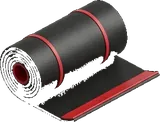



A flat roof in a hot climate has two jobs: keep water out and keep heat out. That takes two materials working as one system — a bitumen membrane for waterproofing and XPS boards for thermal insulation — and the order you stack them defines the roof.
Why XPS on roofs
Extruded polystyrene is the roof insulation of choice because its closed-cell structure barely absorbs water (≤0.7% by volume), it carries real loads (200–300 kPa across Blue Foam, Iso Foam and Insu Foam), and its thermal conductivity is a stable λ 0.033 W/m·K. Wet insulation is failed insulation — which is exactly why XPS, not open-cell materials, goes on roofs.
The inverted roof (the regional standard)
The build-up, bottom to top: structural deck → screed to falls → bitumen membrane (InsuGrand or InsuFort, torch-applied) → XPS boards laid loose → separation layer → ballast, tiles or paving.
Putting the insulation above the membrane shields the waterproofing from UV and thermal shock — the membrane lives at a near-constant temperature and lasts dramatically longer. The full system is detailed on the roof insulation solution page.
When the membrane is the top surface
On an exposed roof system the membrane itself faces the weather, taking a mineral or reflective finish to handle the sun — and any insulation sits beneath the waterproofing rather than above it.
One supplier, one system
Insutech is one of the few manufacturers producing both halves of the roof: 38 million m² of bitumen membrane and 200,000 m² of XPS annually, in Egypt — a manufacturer since 1987, CE-marked and exported to 105+ countries. Specifying membrane and insulation from one source means compatible products, one technical contact and one delivery. Request a combined quotation for your roof areas.